
Monday, November 11, 2013
A big THANK YOU
To all of our veterans, who had to endure unspeakable horrors to protect and defend our freedom, our civilization, and our way of life.

The Pride of the American Side
Yesterday was the anniversary of the sinking of the ore carrier Edmund Fitzgerald in a storm on Lake Superior just short of Whitefish Point, Michigan, on the evening of February 10, 1975. The exact cause of the sinking is still unclear, but was most likely caused by the accidental grounding of the Fitzgerald (caused by the storm-related loss of her radars) on a poorly-charted reef, which caused her to ride lower in the water and leave her vulnerable to foundering under a series of rogue waves known as "The Three Sisters."


The Edmund Fitzgerald's skipper, Ernest McSorely, a 44-year veteran of the Great Lakes, was from Toledo, OH, which was also a frequent stop for the ship. Thus, her sinking was a big story there. My father covered it extensively when he worked for WTOL. They used the same stock picture of the Fitzgerald:
For little 4-year-old me at the time, this picture was both fascinating and frightening. That ominous-looking black crane in the background, apparently used to dispense coal and taconite, looked to this toddler like some sort of monster.
I guess it was best that I never saw this picture:
May Captain McSorely and his crew always be remembered.
Friday, October 25, 2013
A too-novel legal theory of self defense
Criminal defense lawyer Andrew Branca highlights this weird story from Colorado:
A Colorado judge denied immunity under the state’s “Make My Day” law to a woman charged with 1st degree murder. The defendant, Marla Abling, has been charged with first degree murder for the strangulation killing of her estranged boyfriend, Rory Alba.You don't need a law degree to get to the logical heart of this self-defense claim, but Branca, a specialist in the law of self defense, gives it anyway, in the somewhat understated form for which we lawyers are generally known:
The couple had a history of alleged domestic violence, and Abling had obtained a temporary restraining order that forbid Alba from going to Abling’s apartment. Despite this, Alba was in Abling’s apartment when she killed him.
Abling made a pre-trial motion for immunity from criminal prosecution under Colorado’s “Make-My-Day” law. In relevant part, §18-1-704.5 “Use of deadly physical force against an intruder” authorizes the use of deadly force, and provides both criminal and civil immunity for such use of force, even against a person who does not present an imminent threat of death or grave bodily harm if all of the following conditions are met:(1) The person using the deadly defensive force is the occupant of a dwelling at the time, ANDAbling argued that she meets the conditions of the “Make-My-Day” law because (1) she was the occupant of the dwelling; (2) Alba’s entry into the dwelling was unlawful because of the presence of the temporary restraining order; (3) based on his prior conduct she had a reasonable belief that he intended to commit a crime in addition to the unlawful entry; and (4) for similar reasons she had a reasonable belief that he might use physical force against her.
(2) The person against whom the deadly defensive force is used has made an unlawful entry into the dwelling, AND
(3) The occupant has a reasonable belief that the other person has committed a crime in the dwelling (in addition to the uninvited entry) OR the other person is committing or intends to commit a crime (in addition to the uninvited entry) AND
(4) The occupant reasonably believes that such other person might use any physical force, no matter how slight, against any occupant.
Unfortunately for Abling, however, over the course of six days of testimony on the immunity motion, the prosecution presented evidence that convinced the judge that Abling’s conduct did not fall within the scope of the “Make-My-Day” statute.
There was evidence that Alba may have been invited to the apartment by Abling, rather than being an intruder. Phone records indicated ongoing and mutual communication between Alba and Abling, and the two had also been seeing together around town, despite the prohibitions against this by the restraining order.
Further, Alba’s keys were found hanging neatly on the key hook by the front door. It also appeared that Alba spent hours at the apartment with Abling before he was killed, and that the two may have engaged in consensual sex during that time. All of this seems behavior more consistent with that of an invited (and welcome) guest than of an unwanted intruder.
Most damning, however, was the prosecution witness that testified to overhearing Abling at a hair salon days before Alba’s death talking about ways to kill him. Oops.
[W]hile I have seen a great many items used as defensive weapons in my years as a defensive trainer and in my legal work in the law of self-defense, the claimed necessity to kill an attacker by means of strangulation via electrical cord is certainly novel to my experience.I wonder if Abling will next try the Chewbacca Defense.
Thursday, October 17, 2013
Book review -- John Bell Hood: The Rise, Fall, and Resurrection of a Confederate General.
Sorry for the extremely light posting. Between work and final preparations for the book, I’ve had very little time for blogging, though if you follow my Twitter feed I’ve been fairly active over there.
But it has not stopped me from reading my usual dozen or so books at one time, so let’s do a book review.
My latest interesting read is John Bell Hood: The Rise, Fall, and Resurrection of a Confederate General, by Stephen M. “Sam” Hood, who is a distant relative of John Bell Hood.
John Bell Hood is a controversial figure in Civil War histories, generally seen as brave (he lost the use of one arm and one leg to battle wounds), but overly aggressive and rather stupid. He is most (in)famous for the ill-fated 1864 Nashville Campaign, in which he led the Confederate Army of Tennessee in an invasion of its namesake, with the operational objectives of liberation of the state and potentially driving up to the Ohio River, and the strategic objectives of forcing Union General William T. Sherman to abandon his march to the sea and move west to stop Hood.
It was a desperate move, but by this point in the war with the Mississippi, Chattanooga, and Atlanta now in Union hands, the Confederacy was well-past desperation.
Sherman did not move west. To stop Hood’s move, Union General George (“Rock of Chickamauga”) Thomas was collecting federal troops in a blocking position at Nashville, which had been held by the Union for 3 years and was heavily fortified. The trick was that those troops had to beat Hood’s army to Nashville.
For Union General John Schofield, this was kind of a problem, since his troops were directly in Hood’s line of march. That problem became a grave crisis on November 29, 1864, when Hood managed to outflank Schofield and get between the Union army and Nashville near Spring Hill. But through command and control problems and a poor deployment of the army, Hood’s troops did not block the road which Schofield was using to march to Nashville, and Schofield’s troops marched within a football field of Hood’s sleeping troops during the night and escaped. When Hood woke up the next morning, he went had breakfast with his senior generals at a mansion with the bizarre name of Rippavilla and supposedly threw a tantrum for the ages.
Schofield continued his flight northward towards Nashville, but was blocked by the flooded Harpeth River at the town of Franklin. As his forces repaired two damaged bridges and started his supply train across, his infantry and artillery were forced to deploy in defensive positions facing south. Sure enough, late that afternoon, Hood’s troops caught up with him.
The result was the Battle of Franklin, one of the bloodiest battles of the Civil War and Hood’s most controversial action. With the fading light, Hood ordered a frontal assault, and the Confederate infantry charged over two miles of open ground with no artillery support against prepared Union positions with enfilading artillery coverage from an artillery position on the north side of the Harpeth called Fort Granger. It was a slaughter. The Confederates suffered 6,252 casualties, including 1,750 killed and 3,800 wounded. Fourteen Confederate generals (six killed or mortally wounded, seven wounded, and one captured) and 55 regimental commanders were casualties. Among the dead were “The Stonewall of the West” Patrick Cleburne and the talented States Rights Gist (yes, that was his real name).
As one might expect given that Sam Hood is a relative of John Bell Hood, John Bell Hood is a defense of the Confederate general. In fact, it is more of a defense than it is a history, and it, while it does present excerpts of many of the accusations against Hood, assumes considerable knowledge on the part of the reader of both the Civil War and the conventional opinion of Hood’s actions.
One might say that at times Sam Hood tries too hard to defend the general. One of the generally accepted beliefs is that Confederate General Robert E. Lee had a low opinion of General Hood and was not happy at the prospect of his selection for commander of the Army of Tennessee to replace General Joseph Johnston (himself another controversial figure) during the Atlanta campaign. Sam Hood, who is honest in presenting contradictory evidence, gives Lee’s statements about John Bell Hood to Confederate President Jefferson Davis. First is this:
Telegram of today received. I regret the fact stated. It is a bad time to release the commander of an army situated as that of Tennessee,. We may lose Atlanta and the army too. Hood is a bold fighter. I am doubtful as to other qualities necessary. (Page 12.)
Lee would later elaborate:
I am distressed at the intelligence conveyed in your telegram of today. It is a grievous thing to change the commander of an army situated as that of the Tennessee. Still if necessary it ought to be done. I know nothing of the necessity. I had hoped Johnston was strong enough to deliver battle. We must risk much to save Alabama, Mobile and communications with the Trans Mississippi. It would be better to concentrate all of the cavalry in Mississippi and Tennessee on Sherman’s communications. If Johnston abandons Atlanta I suppose he will fall back on Augusta. This loses us Mississippi and communications with Trans Mississippi. We had better therefore hazard that communication to retain the country. Hood is a good fighter, very industrious on the battle field, careless off, and I have had no opportunity of judging his actions, when the whole responsibility rested upon him. I have a high opinion of his gallantry, earnestness and zeal. General (William) Hardee has more experience in man aging an army. (Pages 12-13.)
Sam Hood’s conclusion:
In the morning, Lee had rejected not Hood, but rather the act of changing the Army of Tennessee’s command. However, later that same day, after considering the broad geopolitical and military consequences of losing Atlanta, Lee agreed that a change in commanders was necessary. Lee, upon further thought, seemed to endorse Hood, making five positive comments and one negative about his former subordinate. Lee […] noted only Hardee’s previous army management experience but had nothing else to say about him. […]
Lee’s cautious advice to Davis about one of his favorite former subordinates an hardly be taken as a rejection of the proposal to install Hood, although many authors and historians have stated that Lee advised against elevating Hood. The full text of Lee’s longer reply to Davis, rarely provided by authors, speaks for itself. (Page 13.)
Indeed it does, but it does not say what Sam Hood says it says. He calls Lee’s response “cautious” and says Lee “seemed to endorse Hood.” Really? Given that John Bell Hood was indeed one of Lee’s favorite subordinates, don’t you think he would have given a more glowing endorsement than this? If Lee was endorsing Hood, so you think he would have ever said “I am doubtful as to other qualities necessary?” Lee compliment’s Hood’s bravery and fighting ability, but little else. Lee’s statements read like specifically not endorsing Hood while not coming out and saying as much, so as not to be seen as betraying a friend.
For a second example, Sam Hood tries very, very hard to refute the charge that John Bell Hood accused his troops of cowardice, especially after the “affair” at Spring Hill. He does present the quote that is used to support the charge, which comes from John Bell Hood’s own memoirs Advance & Retreat. The quote is a full paragraph:
The best move of my career as a soldier, I was thus destined to behold come to naught. The discovery that the Army, after a forward march of one hundred and eighty miles, was still, seemingly, unwilling to accept battle unless under the protection of breastworks, caused me to experience grave concern. In my inmost heart I questioned whether or not I would ever succeed in eradicating this evil. It seemed to me I had exhausted every means in the power of one man to remove this stumbling block to the Army of Tennessee. And I will here inquire, in vindication of its fair name, if any intelligent man of that Army supposes one moment that these same troops one year previous, would, even without orders to attack, have allowed the enemy to pass them as Rocky-faced Ridge, as he did at Spring Hill. (Page 214.)
Sam Hood comments:
Nowhere do the words “fear,” “bravery,” “cowardice,” or “courage” appear in this or any other paragraph relating to this event. All Hood explained was his frustration at the army’s apparent unwillingness to accept battle unless from behind breastworks, which he believed was a “stumbling block” instilled by the tactics of the previous commander. (Page 214.)
A fair interpretation, but by no means the only one or, in my opinion and that of many other historians, the most likely one. For one thing, you do not need to use the words “fear,” “bravery,” “cowardice,” or “courage” to accuse someone of cowardice. Just call them “chicken.” Accusing someone of an “unwillingness to fight” someone unless behind breastworks can reasonably (and easily) be interpreted as cowardice.
Such stretches are found throughout the book. But that is merely a minor note. Most of Sam Hood’s defenses of John Bell Hood are well reasoned, worthy of consideration, and in many cases persuasive. For instance, as ugly and perhaps Quixotic as the Nashville campaign was, it was done with the complete knowledge and support of Jefferson Davis. Far from keeping Richmond in the dark as to the desperate plight of his army, Hood kept them well informed. Hood also did try his best to take care of his troops, requesting reinforcements and supplies at every opportunity, only to be repeatedly turned down. Sam Hood presents John Bell’s Hood’s tactics as desperate but defensible, which is a reasonable position.
Sam Hood’s John Bell Hood is more case than history, and not always a convincing case, but it presents enough of a case to merit a re-examination of John Bell Hood. And it is a very enjoyable read. The publisher Savas Beatie has made a habit of making high-quality history books focusing on the United States. This is yet another. While not agreeing with all of Sam Hood’s conclusions, it is well worth it to buy John Bell Hood: The Rise, Fall, and Resurrection of a Confederate General and decide for yourself.
Friday, September 20, 2013
Ancient mysterious ruined cities
Nice Australian piece giving snapshots of what they call "Ancient ruined cities that remain a mystery." Not sure I agree that Pompeii "remains a mystery" but they have some fun choices here. My favorites:
As I said above, I probably would not have put Pompeii on this list, since we know so much about its demise. Hisarlik, the site generally but not universally believed to be the mythical city of Troy/Ilion, fits much better, because we still don't know why, how or at whose hands Troy ended. For that matter, we don't know that about Mycenae or pretty much any other place in Bronze Age Greece.
But perhaps the most mysterious city that deserves to be on this list is Mohenjo-daro, in the Indus River Valley of Pakistan. Of all the ancient civilizations whose ruins have been identified, Mohenjo-daro may be the one about whom the least is known. I'll let Exploring Dystopia take it from here as to some of the creepy details:
The statue is generally known as the "Priest King," presumably because he bears an eerie resemblance to Christopher Lee. In reality, no one knows what the statue represents or what it was for.
Which is pretty much par for the course for the Indus River Valley civilization of which Mohenjo-daro was a part. Aside from the ruins, we know almost nothing about it. And unless we can find a sort of Rosetta Stone that allows us to decipher its language, we may never know much more about Mohenjo-daro.
Derinkuyu, TurkeyThis one I had not heard of. Sounds like a fascinating way of life. I'm wondering if this was referenced in Assassin's Creed: Revelations.part of which took place in an underground Christian city in Cappadocia.
The largest and deepest of 200 underground cities in the Cappadocia region, this eerie location was home to approximately 20,000 people (plus livestock, a church, school and kitchen). The inhabitants dug tunnels and rooms beneath their homes in the soft volcanic rock.
The city reportedly grew to 85 metres and 11 levels deep. It is believed to date back to the early Byzantine Empire, as early as the 7th-8th centuries.
People fled to the area to find safety from anti-Christian Romans, bandits, and later on, anti-Christian Muslims. Huge rocks were rolled across the entrances, with air shafts letting fresh air in. It was sealed up at some point after the 10th century but reopened in 1969.
Machu Picchu, PeruMachu Picchu has been called "The Lost City of the Incas," but actually it is not. The term "Lost City of the Incas" is actually a reference to Vilcabamba, which was actually the last capital and refuge of the Incas and was destroyed by the Spanish. The location of Vilcabamba had been lost for almost 400 years. For a while Machu Picchu was thought to be Vilcabamba, but Machu Picchu was intact, had not been touched by the Spanish, and may not have even been a town at all, but some sort of religious center. Works starting in the 1970s going up to 2000 have definitively identified the site of Vilcabamba as a site deep in the Ecuadoran forest known as Espíritu Pampa, which from a development standpoint was a steep drop from the Inca heyday in Cuzco.
It's the destination at the top of many travellers' bucket lists. The spectacular 'lost city' of Machu Picchu in Cusco was discovered in 1911 and is one of the most famous sites created by the Inca Empire.
In a remarkable feat of 15th-century construction, the Incas flattened the top of the 2430 metre high mountain to accommodate 140 structures including temples and houses. The city was divided into areas for royalty and the lower classes.
And it's not the jawdropping architecture that's the most puzzling part of Machu Picchu. How they ran a vast empire in an isolated area of Peru without building any marketplaces is quite puzzling, and dramatically different to most other old cities, where market squares were key. Why did they have no recognisable economy, and how did they prosper without it?
Great ZimbabweGreat Zimbabwe is a rather curious case. It's peak may have been 1200-1450, but technologically the town looks more like Bronze Age Mycenae or Troy. No one knows why Great Zimbabwe fell, though as suggested above speculation has focused on famine. Even more curious, no one knows what the purpose was of the Great Conical Tower of Great Zimbabwe. It's completely solid, with no entrance.
The giant, walled and wealthy city of Great Zimbabwe was home to around 30,000 people at its peak in 1200-1450. An important trade centre, it was rich in gold from local mines. The technologically advanced city features a huge enclosing wall some 20 metres high and was believed to have served as a royal palace for the Zimbabwean monarch. Famines may have contributed to its mysterious demise.
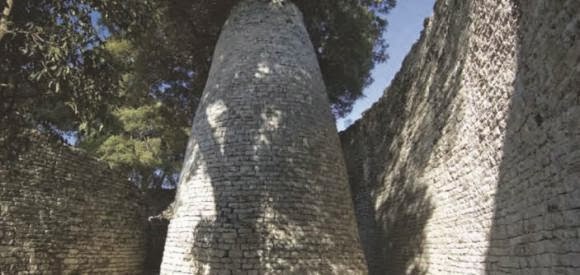 |
| A tower with no entrance: the Great Conical Tower of Great Zimbabwe. |
But perhaps the most mysterious city that deserves to be on this list is Mohenjo-daro, in the Indus River Valley of Pakistan. Of all the ancient civilizations whose ruins have been identified, Mohenjo-daro may be the one about whom the least is known. I'll let Exploring Dystopia take it from here as to some of the creepy details:
In ancient history, advanced civilisations evolved around rivers: Egypt around the Nile river and Mesopotamia around the Eufrat and Tigris rivers. Less well known is the mysterious civilisation which evolved around the Indus river in India, 2500-1500 B.C.That statue of the "man with well-groomed beard, narrow eyes and a subtle smile, described as a tyrannical sneer" is this:
In the old religious texts called Rig-Veda, it is told how the war god Indra — also known as Puramdara, the "castle destroyer" — destroyed ninety fortifications. These castles probably belonged to Dasyas, a people briefly mentioned in the Rig-Veda and described as strangely dark. No ruins were ever found, though, and for many years the Indus civilisation was considered to be a mere myth.
It was not until 1921-22 any remains of this lost civilisation were to be found: the ruins of two cities called Harappa and Mohenjo-daro (the latter means "The Heights of Death"). Unfortunately, building material from the cities had been used by British colonists to build railway embankments, especially in the case of Harappa.
The cities are located in hostile environments, salt desserts with the worst climate in India. The climate was probably more suitable when the cities were built, but it seems conceivable the environment has been at least partly destroyed by merciless exploitation.
Harappa and Mohenjo-daro are twin cities, literally; they have almost identical structures. They are both examples of remarkable city planning. Large boulevards stretches through the cities along a north-south axis and all street and alley crossings have right angels, just like in fairly modern cities.
Judging from the ruins, all appartment buildings were standardised with two floors, small rooms and a courtyard in the center. The building material is baked mudbrick of the same size and weight, which indicates governmental control of weights and measures. Doors and windows always face the courtyards and alleys, never the streets. Thus, the streets of Harappa and Mohenjo-daro were surrounded by plain brick walls. There are almost no decorations, which is remarkable as later Indian architecture is famous for its rich detail.
There are many indications of a strong central government. This is most obvious in Mohenjo-daro, which is better preserved than Harappa. The city plan is dominated by a building complex called the Citadel, which is located on an artificial, 15 meter high hill. The Citadel was most probably the financial and governmental center of Mohenjo-daro and possibly the cult center as well. The largest building is undoubtedly a granary, but it is not known for sure what the functions of the other buildings were. There are indications that the city had a kind of police force, but no military buildings such as castles have been found. Mohenjo-daro also has an advanced sewer system, more advanced than many sewer systems in the Third world today. Hygiene seems to have been important, as there are large baths in both cities and basins in every building.
The Indus writing is yet to be deciphered. Many examples of their writing have been found — on seal stones, pot shards and walls — but they are seldom longer than half a dozen letters. There are few examples of art as well. One of the best preserved stone sculptures depicts a man with well-groomed beard, narrow eyes and a subtle smile, described as a tyrannical sneer. Two anatomically perfect torsos have also been found, so well crafted that many archaeologists doubt their Indus origin. Compared to ancient Egypt and Mesopotamia, there are extremely few cultural findings.
Why the Indus culture ended is uncertain. There are three possible explanations:
- Natural catastrophes such as flooding.
- Thoughtless exploitation such as over-use of the soil.
Very few corpses have actually been found in the ruins and in all cases the cause of death seem to be summary executions. Judging from this, the Indus culture might have ended because of an invasion.
- Conflicts such as invasions or civil wars.
Everyone who have been exploring the cities of Harappa and Mohenjo-daro have found them monotonous and depressing. The cities are strictly utilitarian in their design and there are few, if any, expressions of beauty. Walking through Harappa and Mohenjo-daro has been described as walking through the ruins of some modern mining city like Lancashire. The buildings have been compared to Soviet barracks and the Indus culture has sometimes been called "1984 B.C."! There is undoubtedly something cold and anonymous over the Indus culture.
 |
| Count Dooku? Saruman? The "Priest King" of Mohenjo-daro bears an uncanny resemblance to Christopher Lee. |
Which is pretty much par for the course for the Indus River Valley civilization of which Mohenjo-daro was a part. Aside from the ruins, we know almost nothing about it. And unless we can find a sort of Rosetta Stone that allows us to decipher its language, we may never know much more about Mohenjo-daro.
Thursday, September 19, 2013
Where's the outrage now?
Let's turn the way back machine to a few years ago. The Ohio State Buckeyes -- America's Team, Defenders of Western Civilization and All That Is Good About America, was on its way to the Sugar Bowl when it was revealed that several of their players had traded their own property (jerseys, autographs, championship rings; that last bit justifiably enraged Buckeye Nation) for tattoos. For some absurd reason, this was a violation of NCAA rules, but they were allowed to play in the Sugar Bowl. It became a scandal that engulfed head coach Jim Tressel and cost him his job on the grounds that he had not told his superiors and had lied to the NCAA about not knowing of the rules violation. There is considerable belief in Buckeye Nation that Tressel, in fact, did tell his superior, Athletic Director Gene Smith, about the issue and that Smith himself did not tell anyone, lied about it, and scapegoated Tressel to save his own butt.
Through 2011, ESPN consistently had Ohio State on trial. The NCAA sandbagged Ohio State, by, for instance, waiting until receiver DeVier Posey was about to complete his NCAA-mandated suspension before suspending him again, this time for being paid too much at a construction job, even though he was being paid consistent with union-required prevailing wage rules.

Gene Smith, in one of his dumbest and most inexcusable decisions, had the Buckeyes play in the Gator Bowl. The NCAA came down later with a ridiculous punishment: vacating the entire 2010 (which had been stupidly offered by Smith) and 2011 seasons, a one year bowl ban, and some scholarship reductions. The alumni wanted Smith's head, and still do -- he is regularly booed at public appearances. His job may have been saved only by his landing Urban Meyer as new head coach.
The most memorable feature of this "scandal" was the constant coverage and abuse Ohio State took at the hands of the sports media, ESPN in particular. Ohio State and Jim Tressel were vilified.
This was on the heels of the scandal in which Cecil Newton, the father of Cam Newton, was found to have solicited payments from schools who were recruiting his son. The NCAA did nothing about this. So, soliciting payments is OK, but selling your own property is not.
Or is it?
Since then, we've had multiple NCAA scandals, including academic fraud at North Carolina; Oregon paying a recruiting service; prostitutes, drugs, and payments at Miami; DJ Fluker allegedly taking payments at Alabama; Oklahoma State doing ... something ... maybe ...; and Texas A&M's Johnny Manziel selling his autographs. Manziel's case is particularly revealing, but we'll get to that.
The first thing to note here is that all of these scandals combined did not get the coverage the Ohio State matter did. Not even close. Like Caesar in the Senate on the Ides of March, everyone in the media outside Ohio wanted to stick a knife in the Buckeyes, starting with ESPN's Kirk "Culture of Corruption" Herbstriet, a mediocre quarterback for the Buckeyes under the even more mediocre John Cooper.
(You see, you must understand. For those of us who attended Ohio State in the John Cooper era, there is just no getting over it. Every week was like being the Romans facing Hannibal. I call it "Post-Idiotic Stress Disorder.")
Anyway, somehow those knives don't seem to be out for Alabama, or Texas A&M. Oregon got almost nothing of a punishment. As bad as the violations at Miami are alleged to be, the NCAA has been turned into the villain -- and justifiably so -- by its corrupt practices during the investigation. Yet the NCAA was just as corrupt with Ohio State.
Perhaps most infuriating is the Johnny Manziel saga. Manziel sold his own property -- exactly the "crimes" for which Terrelle Pryor, DeVier Posey, and the other Buckeyes were convicted. Yet, while the Buckeyes in some cases were suspended for half the 2011 season (Posey lost the other half of the season for the construction job), Manziel lost ... half a game. Seriously.
For exactly the same crime.
By itself, this should show that the NCAA is nothing but a bunch of lying, corrupt bastards whose "justice" is arbitrary and capricious, and NCAA head Mark Emmert is an arrogant, dishonest, sanctimonious jerk who plays favorites, but if you read Taylor Branch's excellent article "The Shame of College Sports" in the October 2011 issue of The Atlantic, you already knew that.
What's more interesting right now is the, say, "evolution" of the sports media. Those same people who couldn't wait to stick the knives in Terrelle Pryor and Ohio State are lining up to defend Johnny Manziel.
Two-faced? Or double-standard? Yes.
Ramzy Nasrallah details the hypocrisy and deceit by the sports media that piled on Ohio State. So you don't have to. If you are a member of Buckeye Nation like I am, read it and be enraged. And know that ESPN is not your friend.
Through 2011, ESPN consistently had Ohio State on trial. The NCAA sandbagged Ohio State, by, for instance, waiting until receiver DeVier Posey was about to complete his NCAA-mandated suspension before suspending him again, this time for being paid too much at a construction job, even though he was being paid consistent with union-required prevailing wage rules.

Gene Smith, in one of his dumbest and most inexcusable decisions, had the Buckeyes play in the Gator Bowl. The NCAA came down later with a ridiculous punishment: vacating the entire 2010 (which had been stupidly offered by Smith) and 2011 seasons, a one year bowl ban, and some scholarship reductions. The alumni wanted Smith's head, and still do -- he is regularly booed at public appearances. His job may have been saved only by his landing Urban Meyer as new head coach.
The most memorable feature of this "scandal" was the constant coverage and abuse Ohio State took at the hands of the sports media, ESPN in particular. Ohio State and Jim Tressel were vilified.
This was on the heels of the scandal in which Cecil Newton, the father of Cam Newton, was found to have solicited payments from schools who were recruiting his son. The NCAA did nothing about this. So, soliciting payments is OK, but selling your own property is not.
Or is it?
Since then, we've had multiple NCAA scandals, including academic fraud at North Carolina; Oregon paying a recruiting service; prostitutes, drugs, and payments at Miami; DJ Fluker allegedly taking payments at Alabama; Oklahoma State doing ... something ... maybe ...; and Texas A&M's Johnny Manziel selling his autographs. Manziel's case is particularly revealing, but we'll get to that.
The first thing to note here is that all of these scandals combined did not get the coverage the Ohio State matter did. Not even close. Like Caesar in the Senate on the Ides of March, everyone in the media outside Ohio wanted to stick a knife in the Buckeyes, starting with ESPN's Kirk "Culture of Corruption" Herbstriet, a mediocre quarterback for the Buckeyes under the even more mediocre John Cooper.
(You see, you must understand. For those of us who attended Ohio State in the John Cooper era, there is just no getting over it. Every week was like being the Romans facing Hannibal. I call it "Post-Idiotic Stress Disorder.")
Anyway, somehow those knives don't seem to be out for Alabama, or Texas A&M. Oregon got almost nothing of a punishment. As bad as the violations at Miami are alleged to be, the NCAA has been turned into the villain -- and justifiably so -- by its corrupt practices during the investigation. Yet the NCAA was just as corrupt with Ohio State.
Perhaps most infuriating is the Johnny Manziel saga. Manziel sold his own property -- exactly the "crimes" for which Terrelle Pryor, DeVier Posey, and the other Buckeyes were convicted. Yet, while the Buckeyes in some cases were suspended for half the 2011 season (Posey lost the other half of the season for the construction job), Manziel lost ... half a game. Seriously.
For exactly the same crime.
By itself, this should show that the NCAA is nothing but a bunch of lying, corrupt bastards whose "justice" is arbitrary and capricious, and NCAA head Mark Emmert is an arrogant, dishonest, sanctimonious jerk who plays favorites, but if you read Taylor Branch's excellent article "The Shame of College Sports" in the October 2011 issue of The Atlantic, you already knew that.
What's more interesting right now is the, say, "evolution" of the sports media. Those same people who couldn't wait to stick the knives in Terrelle Pryor and Ohio State are lining up to defend Johnny Manziel.
Two-faced? Or double-standard? Yes.
Ramzy Nasrallah details the hypocrisy and deceit by the sports media that piled on Ohio State. So you don't have to. If you are a member of Buckeye Nation like I am, read it and be enraged. And know that ESPN is not your friend.
The simple fact
of alliances shifting all the time, from war to war, from year to year, based on strategic or tactical needs, is the subject of my latest column for Independent Voter Network. Short story long: the prospect of our siding with al Qaida to defeat Bashar Assad is no more strange or devious or unusual than Persia siding with Sparta to defeat Athens.
Subscribe to:
Posts (Atom)