Friday, September 20, 2013

Ancient mysterious ruined cities

Nice Australian piece giving snapshots of what they call "Ancient ruined cities that remain a mystery." Not sure I agree that Pompeii "remains a mystery" but they have some fun choices here. My favorites:
Derinkuyu, Turkey
The largest and deepest of 200 underground cities in the Cappadocia region, this eerie location was home to approximately 20,000 people (plus livestock, a church, school and kitchen). The inhabitants dug tunnels and rooms beneath their homes in the soft volcanic rock.
The city reportedly grew to 85 metres and 11 levels deep. It is believed to date back to the early Byzantine Empire, as early as the 7th-8th centuries.
People fled to the area to find safety from anti-Christian Romans, bandits, and later on, anti-Christian Muslims. Huge rocks were rolled across the entrances, with air shafts letting fresh air in. It was sealed up at some point after the 10th century but reopened in 1969.
This one I had not heard of. Sounds like a fascinating way of life. I'm wondering if this was referenced in Assassin's Creed: Revelations.part of which took place in an underground Christian city in Cappadocia.
Machu Picchu, Peru
It's the destination at the top of many travellers' bucket lists. The spectacular 'lost city' of Machu Picchu in Cusco was discovered in 1911 and is one of the most famous sites created by the Inca Empire.
In a remarkable feat of 15th-century construction, the Incas flattened the top of the 2430 metre high mountain to accommodate 140 structures including temples and houses. The city was divided into areas for royalty and the lower classes.
And it's not the jawdropping architecture that's the most puzzling part of Machu Picchu. How they ran a vast empire in an isolated area of Peru without building any marketplaces is quite puzzling, and dramatically different to most other old cities, where market squares were key. Why did they have no recognisable economy, and how did they prosper without it?
Machu Picchu has been called "The Lost City of the Incas," but actually it is not. The term "Lost City of the Incas" is actually a reference to Vilcabamba, which was actually the last capital and refuge of the Incas and was destroyed by the Spanish. The location of Vilcabamba had been lost for almost 400 years. For a while Machu Picchu was thought to be Vilcabamba, but Machu Picchu was intact, had not been touched by the Spanish, and may not have even been a town at all, but some sort of religious center. Works starting in the 1970s going up to 2000 have definitively identified the site of Vilcabamba as a site deep in the Ecuadoran forest known as EspĂ­ritu Pampa, which from a development standpoint was a steep drop from the Inca heyday in Cuzco.
Great Zimbabwe
The giant, walled and wealthy city of Great Zimbabwe was home to around 30,000 people at its peak in 1200-1450. An important trade centre, it was rich in gold from local mines. The technologically advanced city features a huge enclosing wall some 20 metres high and was believed to have served as a royal palace for the Zimbabwean monarch. Famines may have contributed to its mysterious demise.
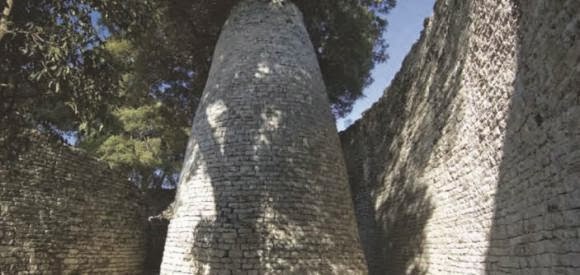
Great Zimbabwe is a rather curious case. It's peak may have been 1200-1450, but technologically the town looks more like Bronze Age Mycenae or Troy. No one knows why Great Zimbabwe fell, though as suggested above speculation has focused on famine. Even more curious, no one knows what the purpose was of the Great Conical Tower of Great Zimbabwe. It's completely solid, with no entrance.

A tower with no entrance: the Great Conical Tower of Great Zimbabwe.
As I said above, I probably would not have put Pompeii on this list, since we know so much about its demise. Hisarlik, the site generally but not universally believed to be the mythical city of Troy/Ilion, fits much better, because we still don't know why, how or at whose hands Troy ended. For that matter, we don't know that about Mycenae or pretty much any other place in Bronze Age Greece.

But perhaps the most mysterious city that deserves to be on this list is Mohenjo-daro, in the Indus River Valley of Pakistan. Of all the ancient civilizations whose ruins have been identified, Mohenjo-daro may be the one about whom the least is known. I'll let Exploring Dystopia take it from here as to some of the creepy details:
In ancient history, advanced civilisations evolved around rivers: Egypt around the Nile river and Mesopotamia around the Eufrat and Tigris rivers. Less well known is the mysterious civilisation which evolved around the Indus river in India, 2500-1500 B.C.
In the old religious texts called Rig-Veda, it is told how the war god Indra — also known as Puramdara, the "castle destroyer" — destroyed ninety fortifications. These castles probably belonged to Dasyas, a people briefly mentioned in the Rig-Veda and described as strangely dark. No ruins were ever found, though, and for many years the Indus civilisation was considered to be a mere myth.
It was not until 1921-22 any remains of this lost civilisation were to be found: the ruins of two cities called Harappa and Mohenjo-daro (the latter means "The Heights of Death"). Unfortunately, building material from the cities had been used by British colonists to build railway embankments, especially in the case of Harappa.
The cities are located in hostile environments, salt desserts with the worst climate in India. The climate was probably more suitable when the cities were built, but it seems conceivable the environment has been at least partly destroyed by merciless exploitation.
Harappa and Mohenjo-daro are twin cities, literally; they have almost identical structures. They are both examples of remarkable city planning. Large boulevards stretches through the cities along a north-south axis and all street and alley crossings have right angels, just like in fairly modern cities.
Judging from the ruins, all appartment buildings were standardised with two floors, small rooms and a courtyard in the center. The building material is baked mudbrick of the same size and weight, which indicates governmental control of weights and measures. Doors and windows always face the courtyards and alleys, never the streets. Thus, the streets of Harappa and Mohenjo-daro were surrounded by plain brick walls. There are almost no decorations, which is remarkable as later Indian architecture is famous for its rich detail.
There are many indications of a strong central government. This is most obvious in Mohenjo-daro, which is better preserved than Harappa. The city plan is dominated by a building complex called the Citadel, which is located on an artificial, 15 meter high hill. The Citadel was most probably the financial and governmental center of Mohenjo-daro and possibly the cult center as well. The largest building is undoubtedly a granary, but it is not known for sure what the functions of the other buildings were. There are indications that the city had a kind of police force, but no military buildings such as castles have been found. Mohenjo-daro also has an advanced sewer system, more advanced than many sewer systems in the Third world today. Hygiene seems to have been important, as there are large baths in both cities and basins in every building.
The Indus writing is yet to be deciphered. Many examples of their writing have been found — on seal stones, pot shards and walls — but they are seldom longer than half a dozen letters. There are few examples of art as well. One of the best preserved stone sculptures depicts a man with well-groomed beard, narrow eyes and a subtle smile, described as a tyrannical sneer. Two anatomically perfect torsos have also been found, so well crafted that many archaeologists doubt their Indus origin. Compared to ancient Egypt and Mesopotamia, there are extremely few cultural findings.
Why the Indus culture ended is uncertain. There are three possible explanations:
  • Natural catastrophes such as flooding.
  • Thoughtless exploitation such as over-use of the soil.
  • Conflicts such as invasions or civil wars.
Very few corpses have actually been found in the ruins and in all cases the cause of death seem to be summary executions. Judging from this, the Indus culture might have ended because of an invasion.
Everyone who have been exploring the cities of Harappa and Mohenjo-daro have found them monotonous and depressing. The cities are strictly utilitarian in their design and there are few, if any, expressions of beauty. Walking through Harappa and Mohenjo-daro has been described as walking through the ruins of some modern mining city like Lancashire. The buildings have been compared to Soviet barracks and the Indus culture has sometimes been called "1984 B.C."! There is undoubtedly something cold and anonymous over the Indus culture.
That statue of the "man with well-groomed beard, narrow eyes and a subtle smile, described as a tyrannical sneer" is this:

Count Dooku? Saruman? The "Priest King" of Mohenjo-daro bears an uncanny resemblance to Christopher Lee.
The statue is generally known as the "Priest King," presumably because he bears an eerie resemblance to Christopher Lee. In reality, no one knows what the statue represents or what it was for.

Which is pretty much par for the course for the Indus River Valley civilization of which Mohenjo-daro was a part. Aside from the ruins, we know almost nothing about it. And unless we can find a sort of Rosetta Stone that allows us to decipher its language, we may never know much more about Mohenjo-daro.

Thursday, September 19, 2013

Where's the outrage now?

Let's turn the way back machine to a few years ago. The Ohio State Buckeyes -- America's Team, Defenders of Western Civilization and All That Is Good About America, was on its way to the Sugar Bowl when it was revealed that several of their players had traded their own property (jerseys, autographs, championship rings; that last bit justifiably enraged Buckeye Nation) for tattoos. For some absurd reason, this was a violation of NCAA rules, but they were allowed to play in the Sugar Bowl. It became a scandal that engulfed head coach Jim Tressel and cost him his job on the grounds that he had not told his superiors and had lied to the NCAA about not knowing of the rules violation. There is considerable belief in Buckeye Nation that Tressel, in fact, did tell his superior, Athletic Director Gene Smith, about the issue and that Smith himself did not tell anyone, lied about it, and scapegoated Tressel to save his own butt.

Through 2011, ESPN consistently had Ohio State on trial. The NCAA sandbagged Ohio State, by, for instance, waiting until receiver DeVier Posey was about to complete his NCAA-mandated suspension before suspending him again, this time for being paid too much at a construction job, even though he was being paid consistent with union-required prevailing wage rules.


Gene Smith, in one of his dumbest and most inexcusable decisions, had the Buckeyes play in the Gator Bowl. The NCAA came down later with a ridiculous punishment: vacating the entire 2010 (which had been stupidly offered by Smith) and 2011 seasons, a one year bowl ban, and some scholarship reductions. The alumni wanted Smith's head, and still do -- he is regularly booed at public appearances. His job may have been saved only by his landing Urban Meyer as new head coach.

The most memorable feature of this "scandal" was the constant coverage and abuse Ohio State took at the hands of the sports media, ESPN in particular. Ohio State and Jim Tressel were vilified.

This was on the heels of the scandal in which Cecil Newton, the father of Cam Newton, was found to have solicited payments from schools who were recruiting his son. The NCAA did nothing about this. So, soliciting payments is OK, but selling your own property is not.

Or is it?

Since then, we've had multiple NCAA scandals, including academic fraud at North Carolina; Oregon paying a recruiting service; prostitutes, drugs, and payments at Miami;  DJ Fluker allegedly taking payments at Alabama; Oklahoma State doing ... something ... maybe ...; and Texas A&M's Johnny Manziel selling his autographs. Manziel's case is particularly revealing, but we'll get to that.

The first thing to note here is that all of these scandals combined did not get the coverage the Ohio State matter did. Not even close. Like Caesar in the Senate on the Ides of March, everyone in the media outside Ohio wanted to stick a knife in the Buckeyes, starting with ESPN's Kirk "Culture of Corruption" Herbstriet, a mediocre quarterback for the Buckeyes under the even more mediocre John Cooper.

(You see, you must understand. For those of us who attended Ohio State in the John Cooper era, there is just no getting over it. Every week was like being the Romans facing Hannibal. I call it "Post-Idiotic Stress Disorder.")

Anyway, somehow those knives don't seem to be out for Alabama, or Texas A&M. Oregon got almost nothing of a punishment. As bad as the violations at Miami are alleged to be, the NCAA has been turned into the villain -- and justifiably so -- by its corrupt practices during the investigation. Yet the NCAA was just as corrupt with Ohio State.

Perhaps most infuriating is the Johnny Manziel saga. Manziel sold his own property -- exactly the "crimes" for which Terrelle Pryor, DeVier Posey, and the other Buckeyes were convicted. Yet, while the Buckeyes in some cases were suspended for half the 2011 season (Posey lost the other half of the season for the construction job), Manziel lost ... half a game. Seriously.

For exactly the same crime.

By itself, this should show that the NCAA is nothing but a bunch of lying, corrupt bastards whose "justice" is arbitrary and capricious, and NCAA head Mark Emmert is an arrogant, dishonest, sanctimonious jerk who plays favorites, but if you read Taylor Branch's excellent article "The Shame of College Sports" in the October 2011 issue of The Atlantic, you already knew that.

What's more interesting right now is the, say, "evolution" of the sports media. Those same people who couldn't wait to stick the knives in Terrelle Pryor and Ohio State are lining up to defend Johnny Manziel.

Two-faced? Or double-standard? Yes.

Ramzy Nasrallah details the hypocrisy and deceit by the sports media that piled on Ohio State. So you don't have to. If you are a member of Buckeye Nation like I am, read it and be enraged. And know that ESPN is not your friend.

The simple fact

of alliances shifting all the time, from war to war, from year to year, based on strategic or tactical needs, is the subject of my latest column for Independent Voter Network. Short story long: the prospect of our siding with al Qaida to defeat Bashar Assad is no more strange or devious or unusual than Persia siding with Sparta to defeat Athens.

Wednesday, September 11, 2013

September 11

The biggest image I had from my first trip to New York City in 1988 was the view of Lower Manhattan and the Twin Towers of the World Trade Center from Liberty Island. I will never forget how gorgeous it was. This is the closest approximation I could find on the Internet.

Thursday, August 29, 2013

Who's buried in Grant's Tomb?

This question comes to mind as I read my latest book acquisition, The Mystery of the Hanging Garden of Babylon: An Elusive World Wonder Traced, by Stephanie Dalley. Because she claims the Hanging Gardens of Babylon were not actually in Babylon. Nor anywhere near Babylon. Because the Hanging Gardens of Babylon were actually in ... Nineveh. Which makes sense, I suppose, since whenever anyone mentions the Assyrians, the first thing you think of is "gardening."

I'm still early in the book, so I'm not in any position to make a determination as to her evidence, but Dalley is a respected archaeologist and appears to have amassed considerable evidence. Aside from dropping a chicken wing on the book, so far I am enjoying it.

The Reichstag Fire and the Muslim Brotherhood

are the topics for my latest IVN column.

Monday, August 26, 2013

Bean weevils help narrow the date of Santorini "Atlantis" eruption

Ooh bean weevil
I believe you had Santorini in sight
Ooh bean weevil
I believe the season you give is right ...


I'm trying to get the song "Dream Weaver" out of my head that these damn bean weevils have put there. But it was worth it:
A new study of insect pests found in an ancient storage jar on the Greek island of Santorini suggests the major volcanic eruption that took place there around 1600 B.C.—and which may have inspired the legend of Atlantis—happened in early summer.
The "Atlantis" eruption was one of the most significant volcanic eruptions in human history. The blast is credited for not only ending the Minoan civilization, but also for affecting ancient Egypt and other communities around the eastern Mediterranean, explained Eva Panagiotakopulu, a palaeoecologist and fossil-insect expert at the University of Edinburgh in Scotland.
Based on previous evidence, scientists had concluded that the eruption happened sometime between 1627 to 1600 B.C. But there has been one important and unresolved question about the event: What season did it take place in?
In a new study, published in a recent issue of the journal Naturwissenschaften, Panagiotakopulu and her team now say that based on insect remains found in a jar containing seeds of sweet peas discovered at the Bronze Age settlement of Akrotiri, they think the eruption occurred sometime between June to early July.
It was only during these months, the scientists say, that the insect, a species of bean weevil, would have had an opportunity to infest the crops and end up in the storage area.
"There is a short window from early to mid summer just after threshing which could justify the assemblage [of insects] recovered," Panagiotakopulu explained in an email.
[...]
Using a new pretreatment method to radiocarbon date a protein called chitin that makes up the insects' shells, the researchers obtained a date range (1744 to 1538 B.C.) for the fossils that agreed with the findings from other studies.
More importantly, though, the scientists realized the insects were their best clue yet about what season the eruption took place in.
Why Is It Important?
Determining the year that a prehistoric volcanic eruption took place is notoriously difficult, Panagiotakopulu explained, and trying to assign a season to one is even harder.
Other researchers have tried to figure out the season of the Santorini eruption by analyzing the distribution of its ash and debris.
"But in our case, we are speaking from the site data," Panagiotakopulu said. "How often can one go back to a prehistoric event and say that it happened during summer?"
What Does This Mean?
The bean weevils found in the jar of sweet peas at Akrotiri were at different stages of their life cycles. The fossil assemblage included larvae, pupae, and adults or "imagines."
This is important, the scientists say, because it suggests the insects were killed as a result of a single event, probably shortly after the seeds were stored away.
Knowing the season may help to determine just what kind of damage was caused by the Santorini Eruption, perhaps the most devastating volcanic eruption in human history. A 2006 article in National Geographic gives some highlights:
A volcanic eruption that may have inspired the myth of Atlantis was up to twice as large as previously believed, according to an international team of scientists.
The eruption occurred 3,600 years ago on the Santorini archipelago, whose largest island is Thera. Santorini is located in the Aegean Sea about 125 miles (200 kilometers) southeast of modern-day Greece (map of Greece).
The massive explosion may have destroyed the Minoan civilization based on nearby Crete.
Writing in this week's issue of the journal Eos, a team of Greek and U.S. researchers estimate that the volcano released 14 cubic miles (60 cubic kilometers) of magma—six times more than the infamous 1883 eruption of Krakatau (Krakatoa). Only one eruption in human history is believed to have been larger: an 1815 explosion of Tambora, in Indonesia, which released 24 cubic miles (100 cubic kilometers) of magma.
[...]
Whether it occurred in one large blast or in a series of smaller events, the eruption produced massive devastation.
In his book Volcanoes in Human History, de Boer [Jelle Zeilinga de Boer, an emeritus professor of geology at Wesleyan University in Middletown, Connecticut -- JC] links the eruption to the demise of the Minoan civilization. The seafaring Minoan culture was based on Crete, which is only a few dozen miles from Thera. At the time of the eruption, they dominated that part of the ancient Mediterranean. When Thera erupted, the Minoans would have been clobbered by tsunamis, overwater pyroclastic flows, and fires from oil lamps knocked over by the eruption's shockwave. Famine, plague, and a destruction of the Minoans' shipping economy would also have followed, de Boer says. The eruption may also have had an enormous impact on Mediterranean mythology. "I have no doubt that every myth is based on some event, and so is the myth of Atlantis," the University of Rhode Island's Sigurdsson said. "An event of this magnitude must have left its imprint." Sigurdsson also sees traces of Santorini in a Greek poem called the Theogony, composed by Hesiod about 800 years after the eruption. The poem describes an epic battle between giants and the Greek gods and includes imagery of a great battle far out at sea. Hesiod must have picked up the story as folklore handed down from survivors close enough to see the event but not close enough to know what happened, Siggurdsson says. "He uses all the terminology one would use in describing an eruption," he said. "The people who lived close enough to see that it was a volcano were all killed. [The rest] could only describe it in supernatural terms."

It's easy to see how a massive eruption at Santorini could have destroyed Minoan Crete. Take a look at the map:

Just imagine the tsunamis that would have hit the north coast of Crete from the Santorini volcanic eruption.